


Carbon accounting for service based companies in North America
Convenient, transparent and custom-tailored to your business needs. All in-line with the Greenhouse Gas Protocol standard.

“Working with Offset Alliance has helped us greatly improve the methodology and transparency behind our efforts to benchmark our member salons’ scope 2 carbon emissions. We appreciate the thoughtful expertise they bring to our partnership.”
–Cheryl Ross, Sustainability Manager, Green Circle Salons, Certified B Corp
How it works
We provide climate expertise typically not staffed by service based companies
1 - Set Boundary
We collaborate to define the most relevant boundary (what will be included) in your carbon accounting. GHG Protocol Scopes 1 and 2, and more personalized Scope 3 based on your business type and activities.
2 - Collect Data
We guide you in the collection of pertinent business activity data that will be needed to perform your carbon accounting. We provide convenient data templates and quick responses to any questions that arise.
3 - Benchmark
We apply the most recent, publicly available emission factors to your reported activity data–for full transparency and consistency, so you have confidence in your carbon accounting and reporting.
4 - Report
We deliver a detailed report (option to also choose a public facing report), including methodologies and emission factors used, as well as any simplifying assumptions applied in order to complete your carbon accounting.
What’s included
A benchmark of the most relevant, operational GHG emissions for a service-based business:
Scope 1: from vehicles and equipment burning fuels
Scope 2: from purchased electricity used at your facilities
Scope 3: everything else that makes your business possible, like employees working from home or driving to work, purchasing goods and services, taking flights and staying in hotels
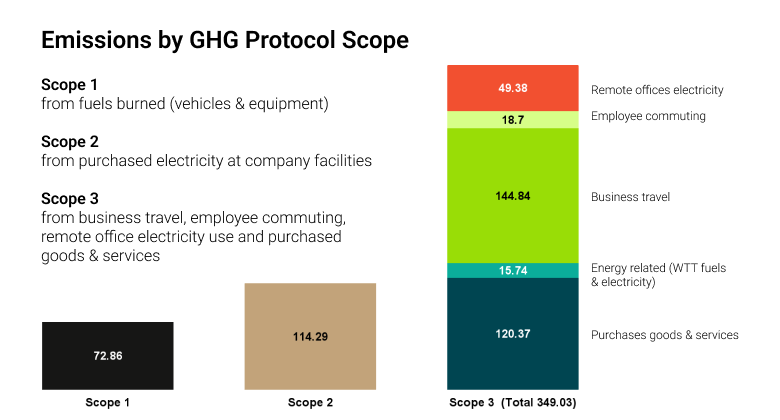
Carbon accounting based on global standards and the most relevant emissions data
Your business CO2 emissions measurement and reporting are aligned to the global standard Greenhouse Gas Protocol, and incorporate the most relevant, publicly available emissions data from governmental and intergovernmental organizations including the US EPA, Canadian Government and United Nations.
